
The 20,000-year-old "oldest math artifact" may not be math
What the marks on the Ishango Bone might actually encode

The Ishango Bone is usually introduced as one of the oldest mathematical objects ever found, with various dating methods placing it at about 20,000 years old. It is a small worked bone, about 10 centimeters long (about the size of a pencil), discovered in 1950 by Jean de Heinzelin near Lake Edward in Central Africa, with a short quartz point fixed to one end and grouped notches carved into the handle. The number and grouping of those notches is what has attracted much attention, and has become the primary focus of attempts to understand the meaning of this artifact.
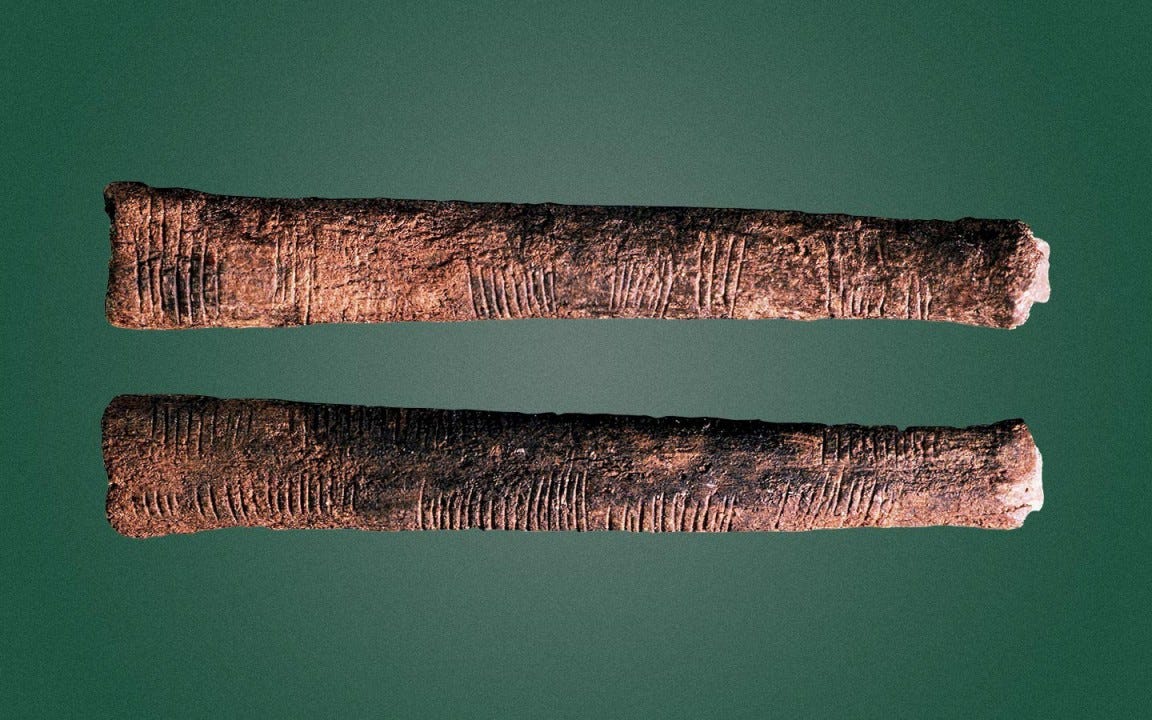
From those notches have come the famous theories about the mathematical knowledge of the ancient person who made them: knowledge of prime numbers, base 10 and 12 counting systems, arithmetic, lunar calendars. De Heinzelin's original 1962 Scientific American article1 opened that line of thought, Alexander Marshack extended it in The Roots of Civilization (1972), and Vincent Pletser and Dirk Huylebrouck have done the most careful recent work on the actual marks.
To their credit, none of these scholars treats the bone as purely numerical, and Marshack in particular was attentive to mark morphology. But the popular reception has flattened the conversation. In summary form — the version that reaches most readers — the Ishango Bone has become a tally stick whose only meaningful property is its counts.
That flattening is the problem. It reduces each notch into an identical count, a simplification that ignores information that goes beyond those counts.
A long notch becomes the same as a short notch. A continuous mark becomes the same as an interrupted mark. A tight cluster becomes the same as a loose cluster. A wedge-shaped group becomes the same as a straight group. A change in angle becomes invisible. A possible punctuation mark becomes just “one more tally.”
This essay proposes a different starting point:
The Ishango Bone should not be analyzed only as a tally stick. It should be analyzed as a multimodal notational object.
Its meaning, if meaning survives, may lie not only in the number of marks, but in their length, spacing, angle, interruption, subgrouping, and contour.
The object
The Ishango Bone is a slightly curved, dark brown bone handle, probably shaped from a baboon fibula, with a piece of quartz fixed to one end. The quartz protrudes only about 2 millimeters and has been described as serving as a blade. 2
That detail matters. A 2-millimeter exposed quartz point does not have the ability to be used as a heavy cutting knife or spear point. It is useful as a controlled surface-marking tool: something closer to a fine engraver, stylus, scarifier, or tattoo-like marking instrument.
The object was found in a rich archaeological context: ivory points, barbed bone points, fish bones, mammal bones, quartzite tools, a decorated bone haft, and human remains. It was not an isolated scratch-marked bone floating free of culture. It belonged to a world of worked bone, composite tools, fishing technology, and marked objects.
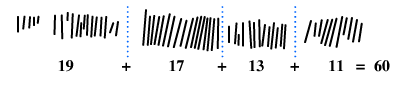
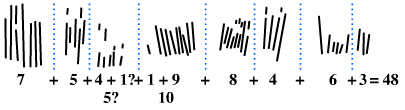
The handle itself bears 168 notches in three columns. The usual counts are:
“G”/left column: 11, 13, 17, 19 = 60
“M”/center column: 3, 6, 4, 8, 10/9+1, 5/1+4, 5, 7 = 48
“D”/right column: 11, 21, 19, 9 = 60
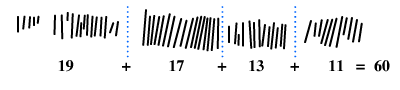
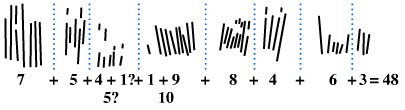
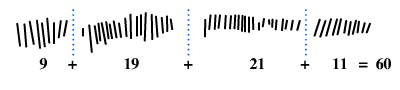
These counts are real enough to deserve attention. The arrangement is clearly not casual. But the counts are not the whole object.
The reduction problem
Pletser's close analysis of the M column states the issue directly: replacing groups of notches with the number of notches is "reducing" the artifact, because information is lost about notch lengths and orientations.3
That sentence is the key.
Once we accept it, the Ishango Bone stops looking like a primitive spreadsheet and starts looking like something more complex: a sign-bearing surface.
In the M column, notch lengths range from very short marks of about 3–4 millimeters to long marks over 20 millimeters. Some groups are horizontal. Some incline upward around 10 degrees. One inclines downward around 10 degrees. Some marks curve at the tip. One disputed mark is interrupted into two pieces.
That is not enough to decode the artifact. But it is enough to say that “one notch = one identical unit” is an oversimplification.
The central column as syntax
The M column is the most interesting part of the object because it is not visually uniform. It has small groups, paired groups, uncertain marks, changing orientations, and internal substructure.
The group counted as six is not simply six identical strokes. Three short central marks are flanked by longer marks, with a final longer mark on one side.
The group counted as eight has two shorter middle marks flanked by two groups of three longer marks, with larger spacing between the internal subgroups.
The group counted as seven is visibly divided into three plus four, with the last four longer than the first three.
These are not just counts. They are shapes.
That suggests the possibility of internal syntax: marks arranged not only to say “how many,” but to create contour, emphasis, subgrouping, and sequence.
The interrupted mark
The most intriguing feature is the disputed interrupted mark in the M column.
Pletser describes a possible tenth notch in the Me group as two parts, about 3 millimeters and 2 millimeters long, separated by a 2-millimeter gap. The total span is about 7 millimeters. He also notes that this mark lies in a damaged surface area, so its interpretation remains uncertain.
That caution is important. The mark may be damage. It may be a tool skip. It may be an incomplete notch. But it may also be something else: a deliberately interrupted sign.
If the two segments were intentionally cut on the same axis, then this is not merely a short tally. It is a different kind of mark.
A continuous line and an interrupted line do not have the same topology. One is whole. One is divided.
In many symbolic systems, that difference matters.
A broken line can mark a pause, transition, absence, division, exception, emphasis, or change of state. In modern punctuation, an exclamation point is a vertical mark divided into two parts. In Morse code, length and spacing carry the information. In the I Ching, solid and broken lines are different symbolic states.
There is no claim here that the Ishango Bone used Morse code, Chinese divination, or modern punctuation. The point is methodological: line form can carry information.
If this artifact was a notational object, then an interrupted mark deserves to be treated as a candidate sign-type, not automatically flattened into “one tally.”
To restate the methodological claim before proceeding: the marks on the Ishango Bone carry more dimensions of information than count alone, and any interpretation that begins by collapsing them to counts is reasoning from an impoverished version of the evidence.
That is the floor of this essay. What follows is one substantive proposal for what a non-flattened reading might point toward.
A chant-score hypothesis
One possible model is that the Ishango Bone did not encode numbers directly. It may have encoded the performance structure of an oral sequence.
In a non-literate society, knowledge is stored in people: memory, chant, gesture, genealogy, ritual, teaching, and repeated performance. A durable mark does not need to contain the whole story. It can point to the story.
This is not a hypothetical mode of knowledge transmission. It is the documented norm across pre-literate cultures on multiple continents, and in many cases the physical objects used to cue oral performance are still studied, still made, or still in living use.
The Andean quipu is the best-known example: knotted cords whose color, position, and knot type encoded census records, accounts, and — recent scholarship increasingly suggests — narrative content. Australian Aboriginal message sticks carry incised marks that cue the bearer’s recitation of a message to a distant community. Closer in geography to Ishango, the lukasa memory boards of the Luba people of Central Africa are carved wooden objects studded with beads and pegs whose spatial arrangement cues the recitation of dynastic history, ritual sequences, and cosmological knowledge by trained members of the Mbudye society. The lukasa is particularly worth attention here: a physically marked Central African object whose explicit function is to externalize knowledge that lives in performance.4
A note on my standpoint. I am part Native Hawaiian. The culture I come from was pre-literate before Western contact and used chants — mele and oli — as the primary technology for storing genealogy, history, navigation, religion, and law. I am not Central African, and I am not claiming cultural continuity between Hawaiian and Ishango traditions. The claim is narrower: someone raised inside a living oral tradition recognizes the category of object the Ishango Bone might be, because objects of that category have not disappeared. They were the norm across pre-literate humanity. Literacy is the exception.
Under this model, each mark on the Ishango Bone could cue a word, name, beat, phrase, ritual act, or breath. The length, spacing, and shape of the marks could cue how the sequence is performed: longer, shorter, louder, softer, faster, slower, broken, emphasized, or paused.
The wedge-like groups may not be sloppy carving. They may be visualized sound: rising intensity, falling intensity, compression, expansion, or transition.
The interrupted mark may be punctuation: a breath, a special word, a change of register, a call-and-response marker, or an exception.
This remains a hypothesis. But it is a hypothesis grounded in how pre-literate knowledge systems demonstrably worked across multiple continents, rather than an interpretive guess in a vacuum. And it explains something the prime-number interpretation largely ignores: why the marks differ so much in physical form.
A specialist’s tool
The quartz point changes the story.
The Ishango Bone is not just a marked object. It is a mark-making object that is itself marked.
That self-reference may matter. If the quartz point was used for engraving, tattooing, scarification, or ritual marking, then the marks on the handle could have been a pattern guide, memory key, ownership mark, initiation sequence, tally of marked persons, ritual schedule, or symbolic record of the tool’s authority.
In a world without writing, a tool that makes durable signs would not be trivial. Permanent marks externalize memory. They make something persist outside the body and outside speech. They turn an event, count, obligation, name, or ritual sequence into matter.
That does not require modern “magic.” It is simply a powerful technology of memory.
What this theory does not claim
This theory does not claim to decode the Ishango Bone.
It does not claim the object is definitely a chant score. It does not claim the interrupted mark is definitely punctuation. It does not claim the object is definitely religious. It does not deny that the counts matter. It does not deny possible arithmetic, calendrical, or counting functions.
It claims something narrower:
The marks should not be treated as identical tally units until their morphology has been fully studied.
The prime-number interpretation, the lunar-calendar interpretation, and the tally-stick interpretation all depend heavily on count. But count is only one dimension of the artifact.
What should be studied next
The next serious study should create a sign inventory of the Ishango marks, focusing on the dimensions most likely to carry information: length, angle, curvature, interruption, surface damage, tool direction, and cutting sequence. Existing traceological methods — stereoscopic microscopy, SEM, experimental replication, blind tests — are well-suited to this kind of analysis.
The interrupted marks deserve particular attention. Did the two halves come from the same tool angle? Do they share the same striation direction? Were they made in one lifted-and-resumed gesture, or are they damage? Are similar interrupted marks found elsewhere on the object?
Conclusion
The Ishango Bone may still be mathematical. But if so, it is mathematical in a broader and older sense than modern arithmetic.
It may join count, gesture, memory, rhythm, and material craft.
The most cautious conclusion is this:
The Ishango Bone is probably a structured notational object. Its marks encode more than raw quantity.
The exact content is unknown. It may have been used for counting, timing, teaching, ritual, oral memory, body marking, or some combination of these. But the physical evidence — and the comparative record of how pre-literate cultures actually preserve knowledge — suggests that the object should not be read only by counting notches.
The marks are not all the same.
And that may be where the signal begins.
de Heinzelin, J. (1962). 'Ishango.' Scientific American 206(6): 105–116. https://www.researchgate.net/figure/De-Heinzelins-faithful-detailed-drawing-of-the-Ishango-bone_fig1_222106237
https://web.astronomicalheritage.org/images/astronomicalheritage.org/thematic-study/ch01cs3.pdf
Pletser, V. ‘DOES THE ISHANGO BONE INDICATE KNOWLEDGE OF THE BASE 12?’. https://arxiv.org/pdf/1204.1019
Roberts, M. N. (1966). ‘Memory: Luba Art and the Making of History’